The reCAPTCHA verification period has expired. Please reload the page.

Commercial/Industrial Solar: An Untapped Clean Energy Opportunity Begins to Emerge

It’s one of the biggest untapped opportunities in the Canadian renewable energy market. 

A well-established but under-utilized pathway for developers and investors to generate steady cash flow with projects that also contribute to local resilience and business continuity, and for governments at all levels to help them get the job done. 

And with interest in commercial/industrial solar on the rise and new financing solutions becoming available, it may be coming soon to an existing building, new construction site, or residential complex near you. 

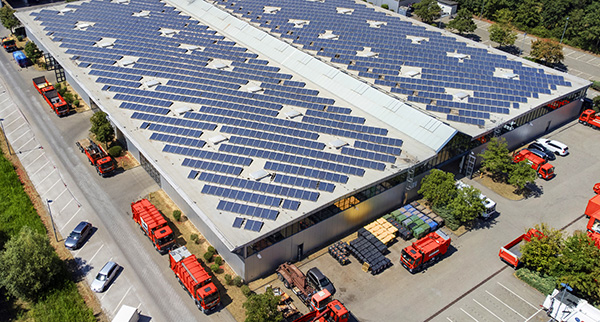
The market segment known as commercial/industrial (C/I) or mid-market solar consists of four- to 50-megawatt installations that are smaller than a utility-scale solar farm but bigger than a home rooftop array. They can be set up to feed electricity directly to the grid. But they’re also the right size to supply distributed, behind-the-meter power where provincial regulations allow them to. 

Either way, a well-designed C/I project can provide steady cash flow for investors and greater flexibility for utilities. Behind-the-meter projects can also give building owners and occupants a decisive advantage by stabilizing and reducing their energy costs while reducing operating emissions. Often an even more important driver, they deliver resilience for buildings and communities and better safety for occupants by keeping the lights on and equipment running when a heatwave, wildfire, or severe storm takes the power grid offline. 

By replacing electricity generated by fossil fuels, commercial/industrial solar projects help governments keep their promises to reduce the greenhouse gas emissions that drive an accelerating global climate emergency while enabling the private sector to make decisions and investments for resilience, economic benefit and environmental performance. All of these advantages demonstrate that the shift to renewable energy is about opportunity and gain, not loss and pain. 

There are no reliable public figures for the number, size, or output of commercial/industrial solar installations in Canada. In the United States, commercial and community solar represented just small slivers of the more than 200 gigawatts (GW) of solar capacity installed nation-wide through June, 2024, according to the U.S. Solar Energy Industry Association. 

But with a new federal tax credit now in place in Canada, commercial/industrial solar has never been more practical or affordable.
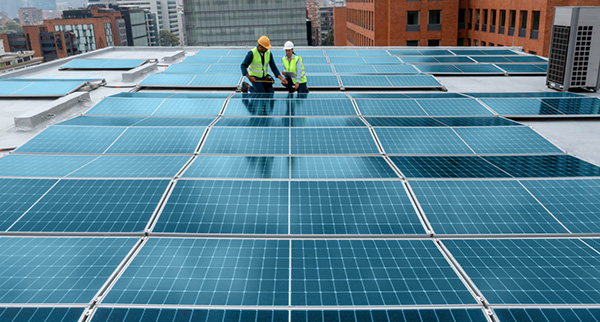
Team of engineers measguring solar panels on a rooftop using a tape measure
Team of engineers measuring solar panels on a rooftop using a tape measure

 A Serious Prospect for Owners and Developers 

Commercial/industrial solar is just beginning to gain recognition as a serious prospect for building owners and solar developers. It’s an obvious consideration for new greenfield development, especially as Canada and other countries move into an intensive period of new home construction. It’s also an opportunity worth exploring for any existing property with roof space, a parking lot, or any other open expanse where it might make sense to install solar panels for commercial/industrial applications. 

And in provinces where net metering programs apply to commercial/industrial solar, developers can send their surplus power back to the grid and receive a credit on their electricity bills. 

In late 2020, energy market analysts at Wood Mackenzie estimated the U.S. potential for new commercial solar capacity at 145 GW. At the time, only 3.5% of commercial buildings were equipped with solar arrays, while another 1% had connected to community solar. 

In 2023, a study for the Canadian Renewable Energy Association (CanREA) found [pdf] that behind-the-meter solar could grow 20- to 40-fold by mid-century, enough to produce 18.8 GW of electricity per year, given the right financial and policy supports to expand the market. (A gigawatt is a billion watts of electricity, but the actual value of that output varies across the country depending on how efficiently a solar array captures energy and how efficiently it’s used. Alberta and Saskatchewan have the best solar resources of any Canadian province.) 

The public release of the CanREA report didn’t differentiate between home rooftops and larger commercial, industrial, or community systems, pointing to a wider set of questions that help define the commercial/industrial potential: 

  • How many warehouses are there in Canada? How many big-box supermarkets or department stores? Or parking lots? Or data centres? 
  • How many square feet of roof space do these, and other facilities, represent, and what share of that total would be suitable for solar development?
  • With the country entering a new boom in home construction and renovation, where are the opportunities to install community solar systems that serve multiple homes, apartment buildings, housing co-ops, non-profit housing developments, or condominiums/stratas, including the large percentage of homes that are locked out of rooftop solar? 

A quick data scan indicates nearly two billion square feet of industrial and logistics sites in Canada (though they aren’t all single-storey), 493 department stores, 71 to 97 million parking spaces, and 336 data centres. 
Those numbers don’t easily translate into a sudden avalanche of project activity. Each site is unique, with its own possibilities, needs, and constraints. But they do point to the opportunity to work from the ground up, building successful projects where owners see the benefits, developers are ready to deliver, and responsive financing is available to seal the deal. 

Getting From Here to There 

For any renewable energy project, developers have to put in the time and effort to get the best energy output from a site, anticipate and minimize impacts on the environment, habitats, and natural heritage, and build a strong base of public support for their plans. 

“Renewable energy project development relies on innovative vision, careful planning, and a lot of hard work,” CanREA writes.

“This applies both to consumers looking to generate and store power at their own property, and to multinational companies wanting to invest in a utility-scale development project.”

But commercial/industrial solar projects face their own special challenges compared to rooftop projects that can be standardized and templated, or utility-scale solar farms that are big, expensive, and profitable enough to warrant one-off contracts and specialized technical and financing arrangements. 

“By contrast, middle market projects don’t have a consistent approach to soft cost management,” one analyst writes. “They lack the standardization of residential projects and the scale of utility projects.” That means “soft costs”, from installation to sales and service, can soak up a much larger share of a budget than they would with a larger project. 

But there are still compelling opportunities to be found, even though they vary from one site to the next. “In this space, the motivation for going solar is often financial, and payback periods are heavily dependent on incentives and utility rate structures,” explains one U.S. solar company. Warehouse owners in one province or state might pay twice as much for peak-period electricity as their counterparts 200 or 2,000 kilometers away. Adding battery storage to a commercial/industrial solar system might unlock big savings on grid electricity from one project or make another one down the road too expensive to build. 

Financing Makes the Difference 

All of which points back to the need for a developer that can navigate the opportunities and complexities at each site. And for a community finance partner like Vancity Community Investment Bank that understands the underlying “why” of renewable energy development, knows the market, and has the patience and flexibility to help structure a deal that delivers on the promised benefits for building owners, developers, and investors. 

In an owner-occupied site, the value proposition for onsite solar might be to reduce and stabilize energy costs and safeguard the many millions of dollars per hour that a large enough business can lose if the power goes out. If the building is leased to commercial or industrial tenants, the owner might try to make their commercial property more valuable in a competitive market by selling reliable, affordable power back to tenants. 

For privately financed solar projects, the federal government’s new Clean Technology Investment Tax Credit offers a rebate for up to 30% of capital costs for investments taking place between March 28, 2023, and December 31, 2034. So, there’s never been a better time for developers and site owners to take a close look at the commercial/industrial solar opportunity. 

Because of the market niche that commercial/industrial solar occupies—large enough to require custom design and financing, but too often considered too small to warrant the deeper investment and bespoke attention that go into a utility-scale development—a successful project depends on developers and lenders that are prepared to sweat the details and work through the hurdles. It’s easier for any institution to justify that extra effort when it is laser-focused on impact—from local economic gain and resilience, to big-picture emission reductions.  

That’s how Vancity Community Investment Bank, as Canada’s only values-driven bank, can deliver the creativity and commitment to support the investments that make a difference for local businesses and communities.

***
If you would like to learn more about VCIB’s Climate Finance solar products, please reach out to Alfred Lee, Manager, Climate Finance at alee@vcib.ca.
Unlocking the power of geoexchange: What every developer needs to know  

Geoexchange systems can decrease a building’s energy use by 33%, greenhouse gas (GHG) emissions by 47%, and are as much as 400% more efficient than conventional HVAC systems 

Besides transportation and electricity supply, one of the main challenges of decarbonizing a city is the heating and cooling of buildings. Outside of a manufacturing facility, heating and cooling systems are the top contributor to a building’s carbon footprint. In Canada alone, buildings take up nearly 30% of all energy consumed and are responsible for 26% of greenhouse gas (GHG) emissions.

Fortunately, the way buildings are being constructed in Canada is changing for the better. With the strengthening of Municipal building codes, real estate/condo developers have increased their focus on energy efficiency. If a developer is looking to meet (or exceed) city or building energy code requirements, implementing a geoexchange system is one of the best ways to do it.

What is the difference between geothermal and geoexchange?

The term “geothermal energy” points to a wide range of technologies. For example, when people talk about conventional geothermal technology they’re often referring to deep-drilled geothermal systems that extract high-temperature heat from kilometers below the earth’s surface – usually seen in industrial geothermal power plants.

Conversely, geoexchange is a form of shallow geothermal technology typically used to heat and cool commercial and residential buildings and houses.

How does a geoexchange system work?

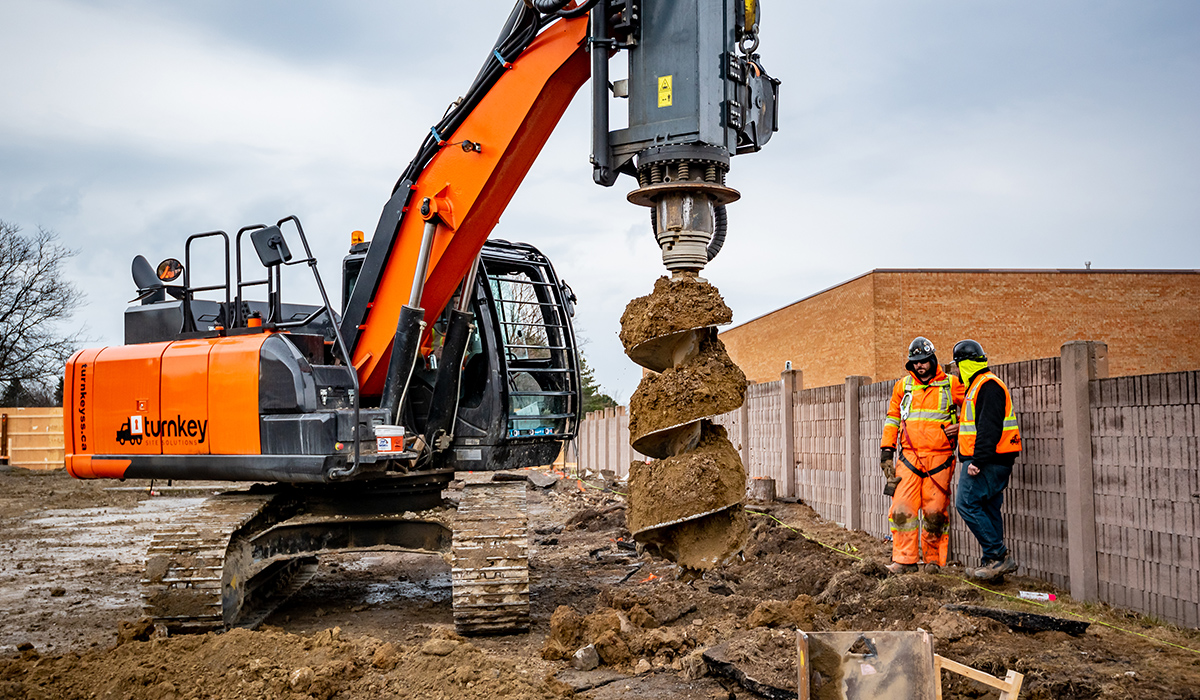
Geoexchange systems use ground-source heat pumps to tap into temperature differentials just below the earth’s surface, typically at a depth between 45 to 120 meters (150 to 600 feet). During the winter, heat (energy) travels through a series of fluid-circulating pipes in contact with the ground.

The pipes use fluids (like water or glycerol) to carry heat from the Earth to the building, providing warmth through a duct system. In the summer, the heat of the building is transferred to the ground and then dissipated through the system’s loops, generating cool air in the process.

What are the benefits of a geoexchange system?

Geoexchange systems use the earth’s temperature to distribute heating and cooling, therefore they don’t require the burning of fossil fuels or any materials to operate. Once installed, the piping doesn’t need maintenance and the above-ground portions of the system require less maintenance than traditional systems.

These systems offer not only environmental benefits but also ensure safety with their odorless, flameless, and carbon dioxide-free operation, eliminating any fire hazards. The comfort of tenants is also enhanced since they provide a well-balanced distribution of heating and cooling, eliminating the common issue of uneven temperatures experienced with conventional systems.

What’s more, a geoexchange system can decrease a building’s energy use by 33%, greenhouse gas (GHG) emissions by 47%, and are as much as 400% more efficient than conventional HVAC systems – which translates into lower electric bills every month.

Breaking the cost barrier

One of the main reasons why geoexchange systems aren’t more commonly implemented is traditional HVAC systems are cheaper to install. Or at least they are initially; given the energy savings, geoexchange systems pay for themselves over time with demonstrated paybacks of between 5 to 7 years.

Targeted financing from the government and government agencies in Canada can also help pay for geoexchange projects. In Toronto, for example, the Toronto Green Standard Development Charge Rebate is available to projects that achieve higher levels of energy and carbon performance. For developers that want to own and finance their system, the Government of Canada provides business income tax incentives under Classes 43.1 and 43.2 in Schedule II of the Income Tax Regulations.

If developers wish to avoid the cost of installing the system altogether, they can engage clean energy utilities or third-party providers like Subterra Renewables, a leading low-carbon district energy developer, to be the owner/operator of the system.

Partnerships to unlock geoexchange potential

Through a construction financing partnership with Forum Equity Partners and Vancity Community Investment Bank (VCIB), Subterra Renewables has supported multiple geoexchange systems in the Greater Toronto Area.

“Despite the clear benefits, residential-scale geoexchange projects are usually too small to attract infrastructure financing from banks or pension funds who are searching for deals of $20 million or more,” explained Alfred Lee, Manager of Climate Finance at VCIB.

“Specialized suppliers of geothermal energy are essential, and we’re stepping up with the financing to help them succeed.”

After financing a half-dozen geoexchange projects, VCIB is a leading Canadian financier for a maturing market that’s ready to take the spotlight.

Financing for every stage of the geoexchange life cycle

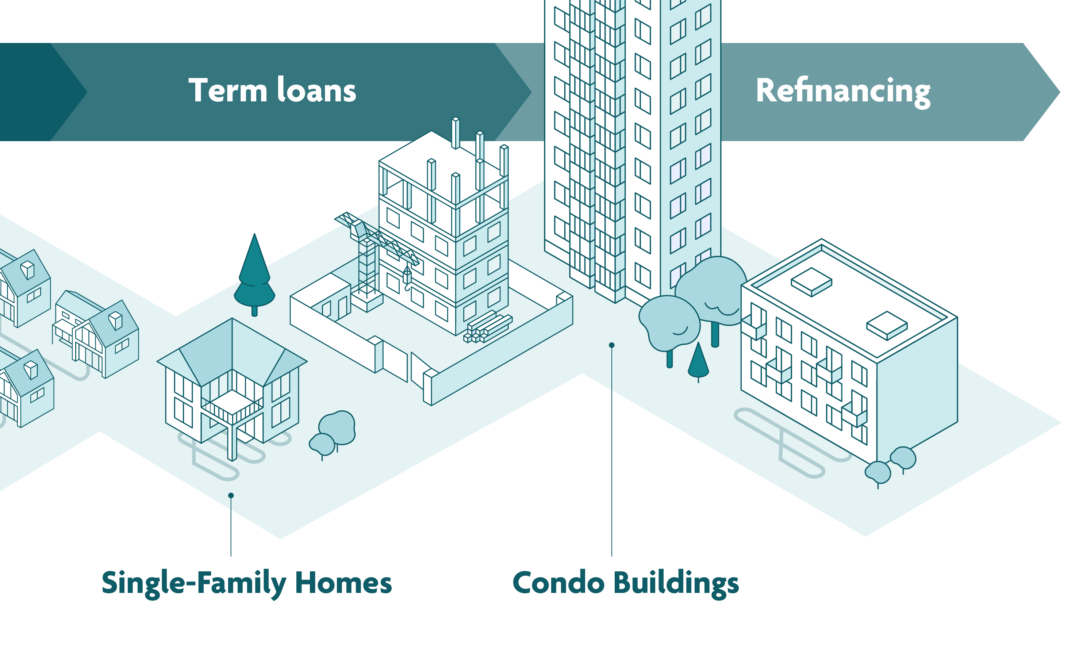
VCIB’s financing covers geoexchange projects across a range of asset classes, types, and geographies — from new builds to refinancing successful projects as they move into the next operational life cycle, and from single-family homes and subdivisions to large condo complexes.

2

Trish Nixon, Managing Director of Climate Finance at VCIB, comments; “We’re seeing a large growth in interest for residential geoexchange as a way to improve residents’ homes. To reduce construction costs, many developers opt for a third-party financing model where a geo utility owns and operates the system.”

***

For more information about geoexchange systems, including common barriers and misconceptions, read this recent study by Urban Equation for Sustainable Buildings Canada. If you’re a real estate developer or clean energy utility looking to finance a geoexchange project, get in touch.

Wind Farm Refinancing Helps First Nation Deliver Community Benefits

For Matt Jamieson, “Indigenous participation in the clean energy economy provides a platform to invest in a brighter future, to stimulate economic opportunity, and build critical capacity to bring about change for Indigenous peoples.”

Jamieson is Chief Executive Officer of the Six Nations of the Grand River Development Corporation (SNGRDC). The SNGRDC was set up to foster economic development opportunities on and around Six Nations’ territory, which is located between Hamilton, Brantford, and Simcoe, Ontario.

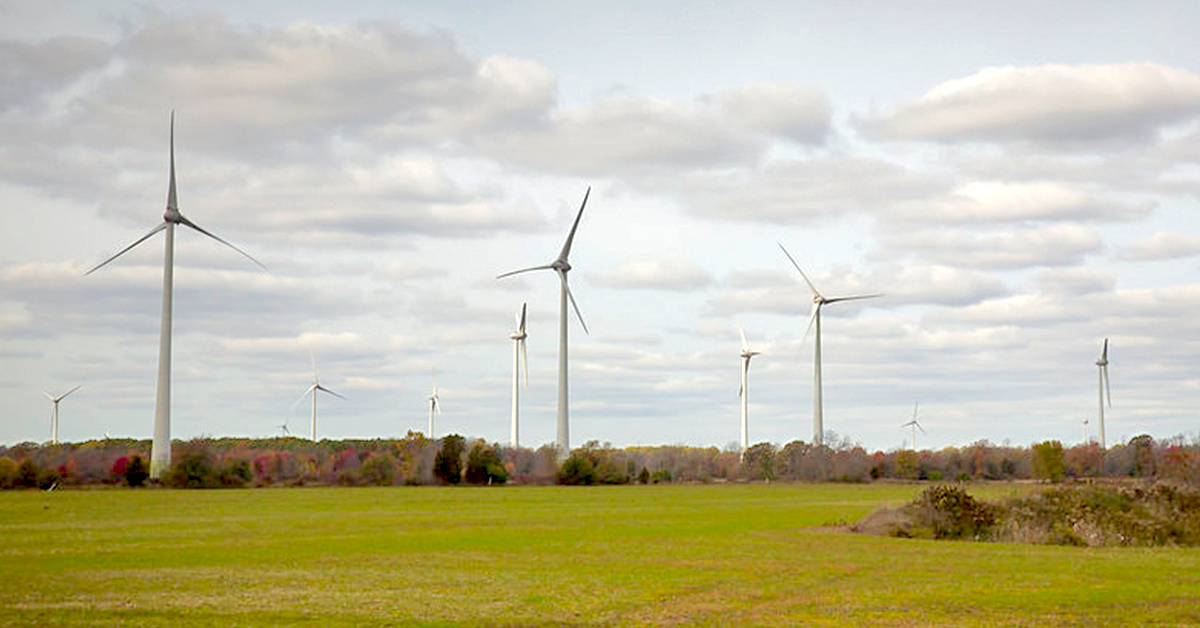
Vancity Community Investment Bank (VCIB) recently partnered with SNGRDC to refinance one project in their growing clean energy portfolio, the Niagara Region Wind Farm. With 77 turbines, it’s the second-largest wind farm in Ontario, yet it’s just one of 18 solar and wind installations that SNGRDC participates in that send nearly 1,400 megawatts of clean electricity to the provincial grid.

NiagaraWind2
Niagara Region Wind Farm

Since 2016, the SNGRDC has reinvested over $14 million in surplus profits, inclusive of wind farm revenues, into critical infrastructure and grassroots projects by way of a community investment trust, the Six Nations of the Grand River Economic Development Trust (EDT).

The SNGRDC was always meant to be an “economic engine” for Six Nations, said Jamieson. So far, with the profits from SNGRDC, the EDT has been able to invest in fire truck purchases, waterline extensions, mental health programs, community living programs, family assault support services, an elders’ home redevelopment, suicide prevention programs, and more.

“In the past century, everything was built around us with little consultation, collaboration, or inclusion,” Jamieson noted. “Throughout this time, Indigenous people were alienated, and their principles and values were dismissed.”

But now, “through Indigenous participation, we have an opportunity to embrace our collective responsibility to do what’s right for our future generations,” he added. “Participating in clean energy provides a platform to invest in a brighter future, to stimulate economic opportunity, and build critical capacity to bring exponential change for Haudenosaunee people and our neighbours.”

Clean Energy Delivers

It’s no coincidence, Jamieson noted, that the “rights and interests of our people are very closely aligned with the clean energy economy.”

Managing large clean energy operations with the intent of directing profits back into the community, SNGRDC sought a financing partner that understood and supported its mission. Earlier this year, VCIB partnered with SNGRDC to arrange a $32.5 million loan, refinancing one part of the development corporation’s 50% ownership stake in the project at a more favourable rate.

This refinancing agreement expanded SNGRDC’s profile as a clean energy leader and, Jamieson added, savings from the lower interest rate “will flow to the bottom line, handing more funds to the EDT and directly benefiting the community.”

SNGRDC website image

Choosing VCIB to refinance the project was as simple as choosing the best lending terms through a competitive process, Jamieson said, while partnering with a financial institution that “demonstrates a strong desire to embrace Indigenous business.”

Supporting Indigenous Business

Partnering to find mutually beneficial solutions has proven to be a successful strategy. In this case, a $23 million loan guarantee from the Province of Ontario’s Aboriginal Loan Guarantee Program “enabled VCIB to provide a larger loan on advantageous terms, which will position SNGRDC to direct more funds back to the community.

“Building critical infrastructure, including energy infrastructure, is part of our plan to drive Ontario’s economic recovery and prosperity,” said Ontario Minister of Finance Peter Bethlenfalvy. “I am pleased that the Aboriginal Loan Guarantee Program has supported this refinancing transaction that will further economic development opportunities for the Six Nations community.”

VCIB uses the tools of finance to drive social and environmental change, and we believe public-private financing partnerships can play a role in advancing community economic development. In addition, “supporting Indigenous economic development is a pillar of VCIB’s values-driven approach,” noted Vince Gasparro, VCIB’s Managing Director of Corporate Development & Clean Energy Finance. “We’re pleased to partner with SNGRDC and the Province of Ontario to find a creative financing solution that benefits the Six Nations community and advances Canada’s net-zero transition.”

This article was written by VCIB and the Six Nations of the Grand River Development Corporation.

First cohort of VCIB’s Solar Partner Program launches with fifteen top-tier installers

Wednesday, July 14, 2021: VCIB is located on the traditional territory of multiple Indigenous nations, including the Haudenosaunee and the treaty territory of the Mississaugas of the Credit/Toronto, ON — Vancity Community Investment Bank (VCIB) is proud to announce VCIB’s first cohort of the Solar Installer Partner Program, 15 leading solar installation companies from coast-to-coast:

Alectric Solar (ON)
Compass Energy Consulting (ON)
KCP Energy Inc. (ON)
Kootenay Solar Corp. (BC)
Kuby Renewable Energy Ltd. (AB)
MiEnergy (SK)
Otter Energy Inc. (ON)
Penfolds Roofing & Solar (BC)
Roost Solar (BC)
Sirius Power Corp. (ON)
Skyfire Energy Inc. (AB)
Solar X Modern Solar Solutions (ON)
VCT Group (ON)
Viridian Energy Co-operative (BC)
Wattsup Solar Ltd. (NS)

As a values-based Schedule 1 bank, VCIB’s mission is to build a sustainable future by using finance as a tool for change. By joining forces with our solar installer partners, our partner program will create a cleaner, greener tomorrow by making it easier for businesses and organizations to adopt solar.

“In 2021, Canadians are waking up to the fact that we have a world-class renewable energy resource.” Said Greg Sauer, VP of Sales at SkyFire Energy Inc. “Businesses are increasingly asking the question ‘does solar PV make sense for us?’ For many businesses eager to reduce and stabilize operating costs and showcase their commitment to their environmental, social and governance (ESG) initiatives, the answer is often yes.”

Even though solar technology is a cost-effective clean energy solution that has been available in Canada for decades, larger scale self-generation solar projects for building owners has seen a slower increase in Canada, with a lack of appropriate financing being cited as one of the main hurdles:

Sauer continues; “We have long sought to find an affordable financing solution for small and medium-sized businesses that is consistent with their needs (e.g. competitive rates, fast approvals and flexible payment options) and that makes it easier for our customers to own their own generation. VCIB’s Commercial Solar Equipment Loans fill a critical gap and as a fellow B Corp, we are 100% comfortable recommending this financing solution to our customers.”

For years, VCIB’s clean energy team has heard installers say that appropriate financing is a much needed tool to ensure all viable solar projects get built. The Commercial Solar Financing Program was created to complement the team’s existing project finance solutions, as Canada’s first dedicated loan program to increase the adoption of self-generation solar projects for commercial building owners.

“VCIB’s Solar Financing was a very welcome addition to our team.” Said Tyler Blower, Founder and Managing Director at Otter Energy Inc. “We have been able to breathe new life into many projects that previously paused due to a lack of solar specific financing.”

In the light of Canada’s new climate commitments, adopting renewable energy is more pressing than ever. Canada has one of the highest per capita power consumption rates in the world, where two-thirds of the energy used by Canadians is derived from non-renewable sources. But with our partners championing the growth of Canada’s clean energy industry, a solar revolution is storming the country.

“Financial institutions have a critical role to play in transitioning Canada away from fossil fuels.” Said Trish Nixon, Managing Director of Commercial Impact Banking at VCIB. “Together with our partners, leaders in the solar installer industry, we’re confident we can make a significant contribution to greening our electric grids using the power of the sun.”

For installers looking to become part of the program, we are still accepting applications for commercial solar installers. To learn more and to get in touch, visit vcib.ca/solar-installers.

About VCIB’s Commercial Solar Financing

VCIB’s Commercial Solar Financing Program provides Canadian businesses and non-profits up to 10 million dollars to install solar panels on their properties. Our fast and flexible solar equipment financing takes clients from application to approval in as short as four weeks to ensure project timelines are met. VCIB’s rates range from 4.5% – 7.5% based on the business’ financials, operating history, and project size. Our financing covers up to 90% of the equipment, installation, and engineering costs of the solar project.

About VCIB’s Solar Installer Partner Program

Our Solar Installer Partner Program is designed for solar installers to connect their commercial clients with fast and flexible financing tailored to suit each company and project. Approved partners are guaranteed that their clients will get their application approved in 4 weeks or less to ensure project timelines are met.

The information provided herein is intended for informational purposes only and is not intended to constitute investment, financial, legal, accounting, tax, or other advice and should not be relied upon for such purpose. Always consult a professional regarding your specific needs and circumstances. Customer results may vary. The customer endorsements that appear on this page were solicited by VCIB.

Stem, Inc. and VCIB announce breakthrough financing for behind the meter energy storage in Ontario

Access to mainstream financing represents the next step toward market maturity for Canada’s emerging energy storage industry.

Thursday, May 6, 2021: VCIB is located on the traditional territory of multiple Indigenous nations, including the Haudenosaunee and the treaty territory of the Mississaugas of the Credit/Toronto, ON — Vancity Community Investment Bank (VCIB), Canada’s first values-driven bank, has announced financing the first tranche of Ontario-based commercial energy storage projects in a portfolio owned and operated by Stem, Inc. (“Stem”) (NYSE: STEM), a global leader in artificial intelligence (AI)-driven clean energy storage services.

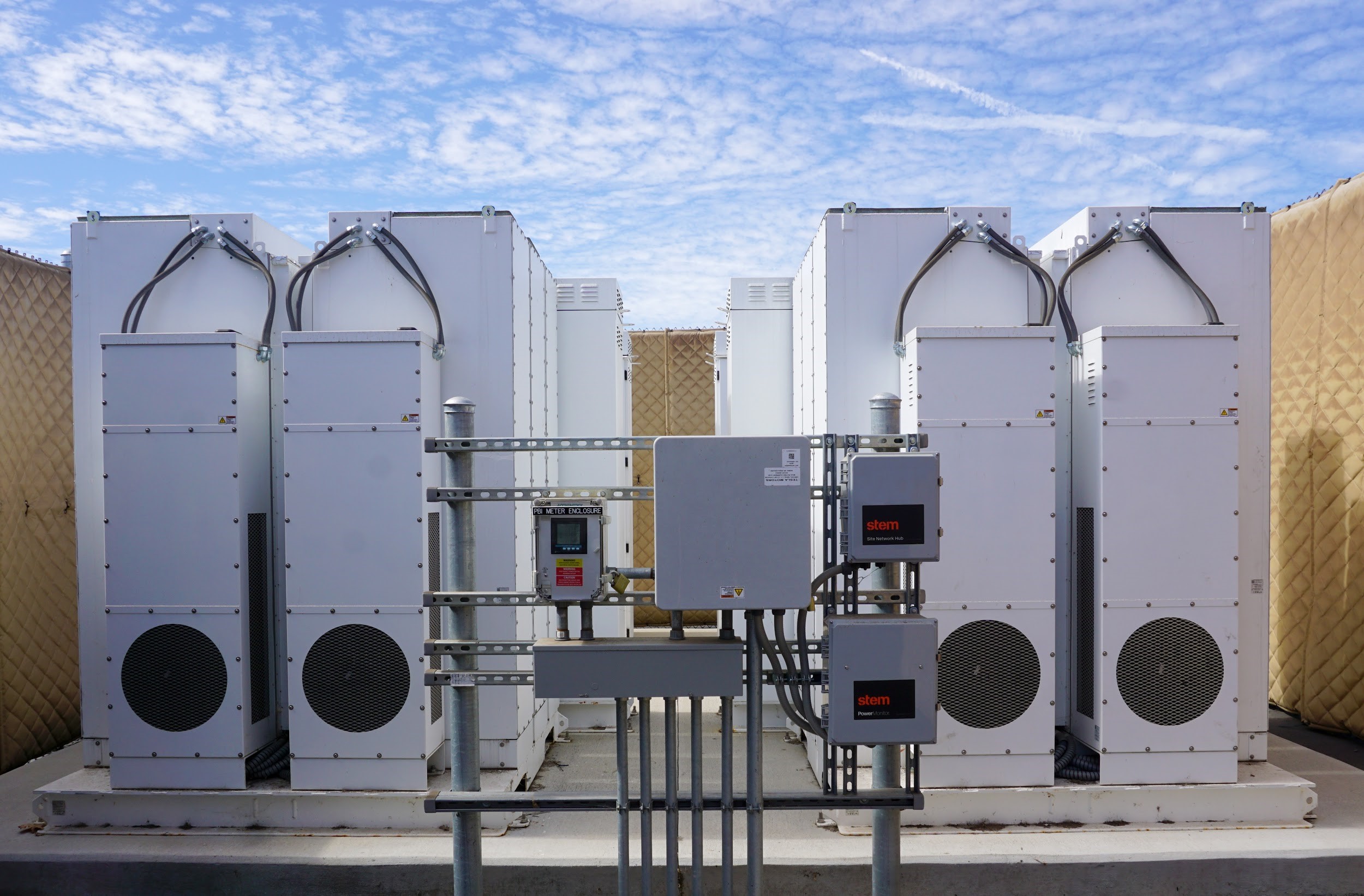
Behind the meter energy storage, an on-site solution to store electricity capacity for use when needed, allows customers to manage costs and reduce emissions. These projects will support several Ontario-based manufacturing and industrial facilities in cutting electricity costs by lowering energy demand at peak times. Stem will also provide additional services directly to the electric grid operator, leading to overall more efficient utilization of energy storage systems.

“We’re pleased to complete this first financing with VCIB and, together, demonstrate the bankability of on-site energy storage,” said Bill Bush, Chief Financial Officer at Stem. “Energy storage is a critical component of reaching a net-zero grid, and the availability of financing by mainstream lenders will go a long way toward accelerating the deployment of these projects in Canada.”

This example of commercial debt financing for behind the meter energy storage projects represents the next step toward market maturity for Canada’s emerging energy storage industry. With VCIB providing a made-in-Canada solution, companies providing energy storage systems will no longer need to solely rely on foreign capital sources.

While these projects will also be responsible for reducing carbon emissions, their primary value is enabling the transition to a decentralized, clean electricity grid. A widespread network of energy storage systems can increase resilience against power outages and provide the flexibility required to increase renewable energy and reduce reliance on natural gas peaker plants.

“Energy storage is a critical component of a modern, low-emissions electricity grid, and while renewable energy has made big strides over the last decade, energy storage has been a missing piece, especially in the Canadian market,” said Jon Frank, Head of Clean Energy at VCIB. “We’re excited to partner with Stem on a breakthrough transaction that will help grow a sector essential to Canada’s net-zero economy ambitions.”

***

About Vancity Community Investment Bank (VCIB)

VCIB is an Ontario-based schedule 1 federally chartered bank and a subsidiary of Vancity Credit Union. As Canada’s first values-driven bank, VCIB provides banking, investing, and financing solutions, to help purpose-driven businesses and organizations thrive, grow, and foster change. Additionally, VCIB offers specialized financing solutions for social purpose real estate and clean energy projects. VCIB is a certified B Corporation and a member of the Global Alliance for Banking on Values. For more information, visit vcib.ca, tweet us at @BankVancity and connect with us on LinkedIn.

About Stem, Inc.

Stem (NYSE: STEM) provides solutions that address the challenges of today’s dynamic energy market. By combining advanced energy storage solutions with Athena™, a world-class AI-powered analytics platform, Stem enables customers and partners to optimize energy use by automatically switching between battery power, onsite generation and grid power. Stem’s solutions help enterprise customers benefit from a clean, adaptive energy infrastructure and achieve a wide variety of goals, including expense reduction, resilience, sustainability, environmental and corporate responsibility and innovation. Stem also offers full support for solar partners interested in adding storage to standalone, community or commercial solar projects – both behind and in front of the meter. For more information, visit www.stem.com.

Forward-Looking Statements

Certain statements in this communication may be considered “forward-looking statements” within the meaning of the “safe harbor” provisions of the United States Private Securities Litigation Reform Act of 1995. For example, projections of future revenue and other metrics are forward-looking statements. In some cases, you can identify forward-looking statements by terminology such as “may,” “should,” “expect,” “intend,” “will,” “estimate,” “anticipate,” “believe,” “predict,” “or“ or the negatives of these terms or variations of them or similar terminology. Such forward-looking statements are subject to risks, uncertainties, and other factors which could cause actual results to differ materially from those expressed or implied by such forward-looking statements. These forward-looking statements are based upon estimates and assumptions that, while considered reasonable by Stem and its management, depend upon inherently uncertain factors that may cause actual results to differ materially from current expectations, including, but not limited to: Stem’s ability to recognize the anticipated benefits of its business combination with Star Peak Energy Transition Corp. (“Star Peak”); the ability of Stem to grow and manage growth profitably; risks relating to the development and performance of Stem’s energy storage systems and software-enabled services; the possibility that Stem’s business, financial condition and results of operations may be adversely affected by other economic, business and/or competitive factors; and other risks and uncertainties set forth in the section entitled “Risk Factors” in the definitive proxy statement relating to the business combination filed by Star Peak on March 30, 2021 and other documents Stem files with the SEC in the future. Nothing in this communication should be regarded as a representation by any person that the forward-looking statements set forth herein will be achieved or that any of the contemplated results of such forward looking statements will be achieved. We caution you that the foregoing list of factors is not exhaustive, and readers should not place undue reliance on forward-looking statements, which speak only as of the date they are made. Stem does not undertake any duty to update these forward-looking statements, whether as a result of new information, future events, or otherwise, except as required by law.

Investor Contacts – Stem
Ted Durbin, Stem, Inc.
Marc Silverberg, ICR, Inc.
IR@stem.com

Media Contact – Stem
Cory Ziskind, ICR, Inc.
stemPR@icrinc.com

The information provided herein is intended for informational purposes only and is not intended to constitute investment, financial, legal, accounting, tax, or other advice and should not be relied upon for such purpose. Always consult a professional regarding your specific needs and circumstances. Customer results may vary. The customer endorsements that appear on this page were solicited by VCIB.

VCIB and Forum Equity Partners: Partnerships for purpose-driven private equity

With $1.4 billion in assets under management and a diverse portfolio that includes real estate, renewable energy and urban infrastructure, Forum Equity Partners is one of Canada’s leading private equity firms focused on sustainable real assets.

In some ways, Forum’s approach looks like that of a traditional private equity firm. Be agile. Be opportunistic. Focus on opportunities that offer aggressive growth and the impressive returns that have consistently put the firm in the top 5% of alternative asset investors in Canada.

But unlike most of its mainstream peers, Forum has taken the responsible step of integrating purpose into investment decisions across its portfolio. They support socially responsible projects that satisfy do-no harm criteria and actively pursue investments that generate measurable impact, leading to exciting partnership opportunities with Vancity Community Investment Bank (VCIB).

“We’ve always had an appetite for innovation, and we think some of the most exciting opportunities for innovation are with companies and projects that are solving social and environmental problems,” said Duncan Ramage, a Partner at Forum Equity Partners. “That’s where we focus our human and financial capital.”

Partnerships for ‘extraordinary outcomes’

While a desire to do right by their stakeholders has been part of Forum’s DNA from the start, in 2015 the team formally articulated its mission, vision and values around creating ‘extraordinary outcomes’ for all stakeholders including employees, suppliers, communities, shareholders and partners.

For Ramage, achieving those outcomes means working with people who share their vision, and in VCIB he found a values-aligned financial partner capable of helping Forum achieve its social and environmental objectives.

“Right away we knew that the VCIB team was in this for the same reasons we are, but they also bring a certain level of expertise in areas that we’re seeking further growth in, like sustainable infrastructure and affordable housing,” said Ramage. “Their thoughtful underwriting and partnership mindset have helped us identify areas to optimize and add value to our investments.”

The relationship began with VCIB providing financing for a portfolio of more than five hundred Ontario-based residential solar rooftop projects acquired by Forum in 2013 and 2014. That solar portfolio represented Forum’s first foray into renewable energy generation. Since then, the team’s understanding of where it is uniquely positioned to contribute to the net-zero transition has evolved.

“We think some of the most exciting opportunities for innovation are with companies and projects that are solving social and environmental problems.”

“For the most part, technologies like wind and solar are now well-understood by traditional investors,” said Ramage. “We see more opportunity in taking on the innovative or niche deals that other institutional investors shy away from.”

They’ve found a sweet spot in revenue-generating distributed energy infrastructure, for example district geothermal projects that employ the energy-as-a-service model, making clean energy more affordable and accessible for property owners while driving down greenhouse gas emissions.

Through a partnership with Subterra Renewables, a geothermal developer and operator, they’re building low-carbon district energy systems across North America, primarily serving multi-residential properties.

“We are bringing geothermal into the mainstream, but we need to make it an easy and cost-effective choice for property developers and owners,” said Ramage.  “Flexible and thoughtful capital sources like VCIB are exactly what allows us to do that.”

“Right away we knew that the VCIB team was in this for the same reasons we are.”

In addition to that first solar investment, VCIB has now partnered with Forum and Subterra Renewables on financing for multiple district geo-exchange projects for towers and townhouse complexes in the Greater Toronto Area.

Building back better

Forum’s foresight and early shift into investments addressing challenges like climate change and the urban affordability crisis have become more apparent during the pandemic.

“Due to the current situation, private equity firms are having to adjust and identify their best path forward,” said Ramage of the impact COVID-19 has had on many sectors. “Forum’s existing focus on sustainability and established partnerships with mission-driven institutions like VCIB are what equips us to emerge from the pandemic more prepared and resilient.”

Today, VCIB and Forum are looking at new opportunities for collaboration, particularly as Forum increases its focus on green buildings and other energy efficiency technologies.

“We are constantly looking for new and better ways to drive sustainability – as well as other ESG objectives – in our investing and development activities,” said Ramage.


Disclaimer: The information provided herein is intended for informational purposes only and is not intended to constitute investment, financial, legal, accounting, tax, or other advice and should not be relied upon for such purpose. Always consult a professional regarding your specific needs and circumstances.  Customer results may vary.  The customer endorsements that appear on this page were solicited by VCIB.

Vancity Community Investment Bank is a member of CDIC and is a Certified B CorpTM